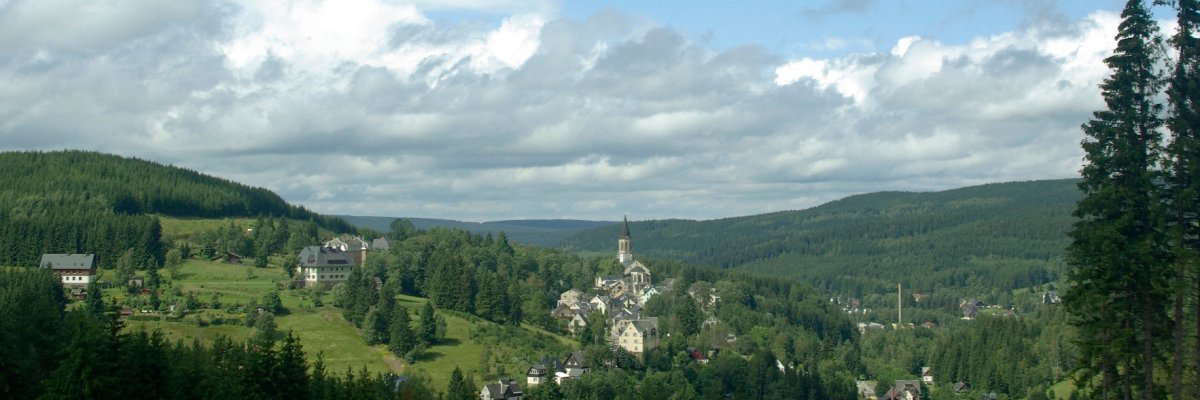
Welcome to the city of the candle arch

Our charming and livable town is situated right on the Czech border in the scenic surroundings of the Western Ore Mountains. At an elevation of 700 to 1,000 meters above sea level, this mountain town—founded in 1654 by Bohemian exiles with the permission of the Saxon Elector Johann Georg I—is the second-highest town in Saxony. Thanks to this location, you’ll find excellent conditions for winter sports here. For example, you can use the ridge trail leading all the way to Schöneck in the Vogtland region, starting from the cross-country ski lodge.
But the roller and skating rink (illuminated in winter), the double T-bar lift, toboggan runs, and an extensive network of cross-country ski trails and hiking paths also offer ideal conditions for an eventful stay.
For fitness and leisure, our town also offers an indoor swimming pool, a natural outdoor pool, the “Franz Mehring” sports and community center, a bowling alley, and mountain bike trails. We
lovingly preserve the old traditions of the Ore Mountains. In the local history museum, you can explore lace-making, woodcarving, shoemaking, as well as the production of leather gloves and Schwibbogen. The Pferdegöpel Mining Technology Museum and the Frisch Glück "Glöckl" educational and exhibition mine bear witness to centuries of mining history.
The City of the Schwibbogen lives up to its nickname. In addition to the largest freestanding Schwibbogen, standing 15 meters high and 25 meters wide, you’ll find larger and smaller examples of this Erzgebirge Christmas symbol—which embodies the spirit of the miners—everywhere. The figures on the 26-meter-high giant pyramid bear witness to the city’s history.
On our website, you’ll find plenty of interesting and informative content about the city administration and various aspects of city life. Let the natural beauty captured by the webcams along the Kammloipe trail inspire you, as well as all there is to experience here. Visit our website to learn about the diverse events in our city.
I cordially invite you to visit our mountain town in person. Good
luck!
Your Mayor, André Oswald
Johanngeorgenstadt in the Ore Mountains
Our mining town, founded in 1654 with the permission of the Saxon Elector Johann Georg I, is located in the southern part of the Erzgebirge district on the Saxon-Bohemian border. For centuries, mining shaped the character of the town. Even today, interested visitors can find many historical remnants from the "Berggeschrey" of that era.
Nestled in the densely forested Western Ore Mountains, the region around the 1,019-meter-high Auersberg offers ideal conditions for both active vacationers and those seeking peace and relaxation. The Auersberg region is considered Saxony’s largest contiguous forest area and offers over 400 km of well-marked hiking trails and nature trails. One of the best-known is the cross-border “Anton Günther Nature Trail,” dedicated to Anton Günther, the Ore Mountains dialect and regional poet. Impressive panoramic views stretching far into the Bohemian Ore Mountains, blooming forest meadows, and wild, romantic valleys alike invite you to explore both the town and the natural surroundings. The Teufelssteine, as well as the “Steinbachtal” nature reserve and the “Kleiner Kranichsee” raised bog, are perfect for nature lovers.
Located at an elevation between 700 and 1,000 meters above sea level, Johanngeorgenstadt is one of the most snow-reliable winter sports destinations in Germany’s low mountain range region. Glistening snow crystals, snow-covered forests, picturesque views across the Ore Mountains, and a winter wonderland await visitors. Numerous sports and cultural facilities offer guests in Johanngeorgenstadt a diverse and varied program. Whether
it’s the double-seater chairlift or the extensive, perfectly groomed network of cross-country trails around the Kammloipe (Schöneck-Mühlleithen-Carlsfeld-Johanngeorgenstadt with connecting trails totaling about 100 km), winter sports enthusiasts will find everything their hearts desire here. However, those who wish to experience the magnificent winter landscape with a touch of romance should enjoy a horse-drawn sleigh ride through the fairytale-like snow-covered forests.
The three drinking-water reservoirs—Sosa at the foot of the Auersberg, Eibenstock (the largest, covering 350 hectares), and Weiterswiese near Carlsfeld (the highest in Saxony)—surrounded by meadows and forests, blend harmoniously into the landscape.
Other tourist attractions and sights include:
- Year-round carving, pyramid and candle arch exhibitions
- Frisch Glück "Glöckl" educational & show mine with mead layer
- Horse gaiter
- Auersberg with observation tower
- Neo-Gothic town church
- Historic postal pillars
- Natural swimming pool "Am Schwefelbach"
- Indoor swimming pool
- Franz Mehring" sports and meeting center
- Climbing center
- Giant pyramid
- Steinbachtal nature trail
- Horseback riding, horse-drawn carriage rides, bowling alley
- Home room
- Scooter and skating track
- Largest candle arch in the world
The busy border crossing in the Wittigsthal district—accessible to pedestrians, cyclists, rail travelers, and motorists—is the ideal starting point for excursions to the neighboring country of the Czech Republic. By train, the Bohemian spa town of Karlovy Vary can be reached through beautiful countryside.
Festivals here are celebrated in the typical Erzgebirge style—extensively and joyfully—such as the annual town founding day on February 23, the garden festivals in summer, the Old Town Festival in late summer, and the Schwibbogen Festival on the third weekend of Advent.
Johanngeorgenstadt is considered the birthplace of the Erzgebirge metal candle arch. The oldest example bears the date 1740 and was crafted by the local mountain blacksmith Teller.